3606 E. Chapman Ave, Orange, CA 92869
Contact us: 714-743-4914
3606 E. Chapman Ave, Orange, CA 92869
Contact us: 714-743-4914

Choosing the right Glass Pitcher in 2026 requires more than comparing photographs and wholesale prices. Global buyers must examine material quality, capacity, heat resistance, pouring control, packaging, and expected daily use. A pitcher for chilled water may need a wide opening and comfortable handle. A model for hot tea requires stronger thermal performance and clear manufacturer guidance.
This guide reviews practical Glass Pitcher types for restaurants, retailers, hospitality suppliers, and household distributors. It considers borosilicate glass, soda-lime glass, ribbed designs, infuser pitchers, lidded models, and stackable options. Each type offers different benefits. Some are elegant but fragile. Others are heavier yet more stable on busy tables. Small details matter, including a drip-resistant spout, a secure lid, and a handle that remains comfortable after repeated use.
Real purchasing decisions are rarely perfect. Product photos can hide uneven rims, weak seals, or difficult cleaning areas. Specifications may also require independent confirmation. Buyers should request samples, inspect surface finish, test pouring angles, and review packaging before placing large orders. Supplier communication matters too, especially when delivery distances are long and replacement parts are limited.
Not every popular design fits every market. Consumer habits, kitchen space, climate, and serving traditions can change the best choice. A careful comparison helps buyers balance appearance, safety, durability, and cost without relying on advertising claims alone. The sections ahead provide a practical framework for selecting reliable glass pitchers with greater confidence.
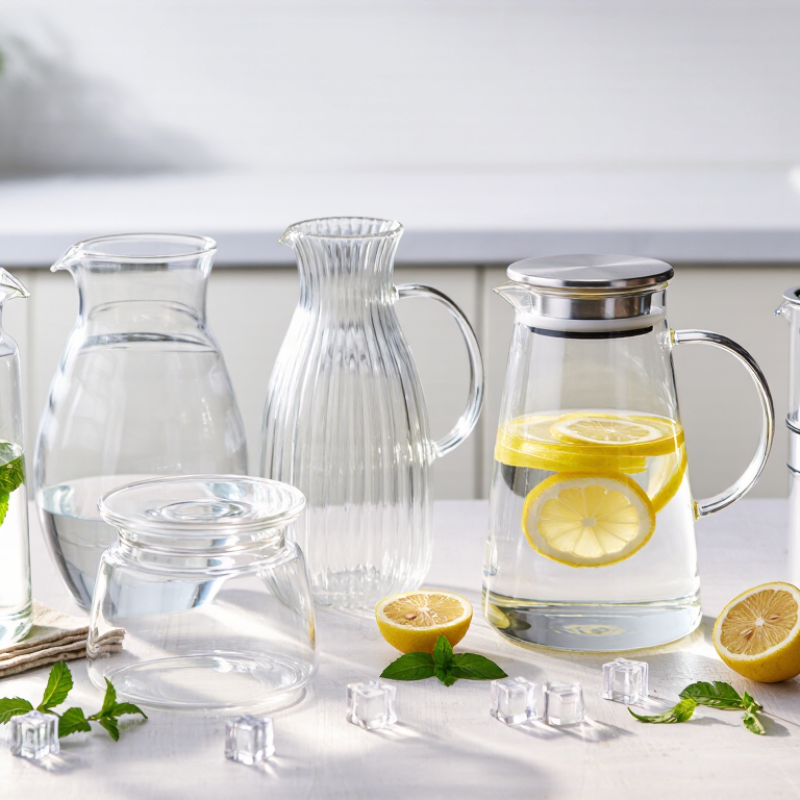
A glass pitcher is a reusable container designed to hold and serve liquids. It usually has a wide body, a stable base, a handle, and a pouring spout. Unlike a glass bottle, it is made for table service and quick refilling. Common uses include serving water, juice, iced tea, infused water, and chilled coffee. A clear body also lets users check the liquid level and notice floating fruit or herbs.
Different glass types suit different needs. Soda-lime glass is practical for everyday serving and usually costs less. Borosilicate glass handles temperature changes better, making it useful for warm tea or chilled drinks. However, no glass pitcher is completely risk-free under sudden thermal shock. Pouring boiling liquid into a cold pitcher can cause cracking. The material alone does not guarantee safety.
In real use, the handle should feel balanced when the pitcher is full. A narrow spout helps reduce drips, while a wide opening makes cleaning easier. A removable lid can help protect drinks from dust during outdoor meals. I have found that attractive designs sometimes sacrifice grip comfort. That detail is easy to miss. Buyers should also check dishwasher guidance, wall thickness, capacity, and replacement-lid availability. For hospitality settings, repeated washing and frequent handling matter more than decorative shape. A pitcher that looks elegant but feels heavy may remain unused.
A handled glass pitcher suits daily water, juice, and iced tea service. Its wide grip helps when the vessel becomes heavy. Look for thick walls, a stable base, and a drip-resistant spout. Borosilicate glass handles temperature changes better than ordinary soda-lime glass. Still, no glass pitcher is completely shockproof. A sudden change from hot liquid to cold water can cause breakage.
A glass carafe works well for dining tables, meetings, and hospitality settings. Its narrow neck can reduce spills and protect the aroma of infused drinks. However, narrow openings are harder to clean by hand. A wide-mouth pitcher is more practical for frequent use. It accepts ice cubes, lemon slices, and a bottle brush without much effort. This small detail often matters more than elegant styling.
For flavored water, choose a pitcher with a removable infuser. It keeps mint, citrus, or berries contained during pouring. Check the filter openings carefully, because fine fruit pulp may block them. A lidded refrigerator pitcher supports cold storage and helps prevent odor absorption. Buyers should also confirm heat resistance, food-contact safety, replacement parts, and cleaning instructions for their market. I would not rely on appearance alone. A beautiful pitcher may feel awkward after several full pours. Testing the handle, lid, and spout with water gives more dependable evidence than photographs.
For global buyers, material selection affects safety, durability, and shipping performance. Borosilicate glass handles temperature changes better than standard soda-lime glass. It suits iced tea, warm water, and repeated household use. However, it is not unbreakable. A reinforced rim and stable base still matter during transport and daily handling.
Design should match the user’s routine. A wide mouth makes cleaning easier and allows fruit, ice, or tea leaves to enter. A narrow spout helps prevent drips on office tables and restaurant counters. Many buyers prefer a comfortable handle with enough clearance for larger hands. A removable lid can simplify washing, while a secure silicone seal reduces spills during refrigerator storage. Details matter.
Functional features should be checked through practical testing, not attractive photos alone. Confirm capacity using real measurements, because advertised volume can exclude the usable pouring space. Check dishwasher guidance, thermal-shock performance, lid fit, and filter stability. A stainless-steel infuser may support loose-leaf tea, but small holes can clog with fine particles. A plastic filter may be lighter, yet it can absorb odors over time. I would also request food-contact documentation and drop-test results from suppliers. A clear pitcher is not automatically a reliable pitcher. Some designs look elegant but feel awkward when full. That weakness is easy to miss until actual use.
Choosing the right glass pitcher for global markets requires more than attractive shape.
Buyers should match the pitcher type with local drinking habits, serving settings, and transport conditions. A borosilicate pitcher suits hot and cold beverages, while soda-lime glass often works well for everyday table use.
For juice, water, or infused drinks, a wide opening makes cleaning easier and allows fruit slices to fit inside. A narrow spout can reduce spills, but it may slow pouring.
Capacity also matters. A 1.5-liter pitcher fits smaller households, while larger models support restaurants and shared offices. The handle should feel balanced when the pitcher is full.
I recommend practical testing with water before placing a large order. Check wall thickness, lid stability, pouring control, and resistance to thermal changes.
Some buyers focus on appearance too much. That can be an expensive mistake. Food-contact documentation, packaging tests, and clear care instructions support reliable international sales. Always confirm the requirements of the target market.
Tips:
For global buyers in 2026, the best glass pitcher depends on use, climate, and compliance requirements. Soda-lime glass suits everyday water service because it offers good clarity and cost control. Borosilicate glass handles sharper temperature changes, but it still needs careful design. Thermal shock is not a marketing detail. It is a real kitchen risk.
Food-contact safety should guide every purchase. Ask for batch traceability, heavy-metal migration results, and testing from a competent laboratory. Requirements vary across markets, including European food-contact rules and United States FDA provisions. The European Food Safety Authority emphasizes exposure assessment and reliable migration data for food-contact materials. Lids, seals, and printed decorations also need testing. Buyers sometimes inspect the glass and forget the silicone ring.
Sustainability needs measurable evidence. The United Nations Environment Programme reported in Turning off the Tap that global plastic pollution could fall by 80% by 2040 through system changes. That supports reusable glass, but glass is heavier to transport. FEVE reports that adding 10% recycled glass can reduce furnace energy use by about 2–3%. Request recycled-content evidence, packaging weight, and transport data. A refillable pitcher with a replaceable lid may outperform a thick decorative model. Not always. We should admit that lifecycle results change with distance, washing habits, and breakage rates.
| Glass Pitcher Type | Typical Material Profile | Safety and Performance Considerations | Relevant Global Compliance Focus | Sustainability Profile | Best-Fit Buyer Requirements | Key Verification Documents |
|---|---|---|---|---|---|---|
| Soda-Lime Glass Pitcher Common everyday option | Silica-based glass with soda and lime; widely used for household food-contact containers. | Good clarity and chemical stability. It is not inherently resistant to sudden temperature changes, so hot-liquid use should be supported by the product specification and testing. | Food-contact material compliance for the destination market, including applicable requirements under EU Regulation (EC) No. 1935/2004 and U.S. food-contact rules. | Highly recyclable where collection and sorting systems exist. Recycled glass cullet can reduce the need for virgin raw materials and may lower furnace energy demand. | Mass-market retail Restaurant use Cost control | Food-contact declaration; migration test report; thermal-shock or temperature-use test; dishwasher-use instructions; packaging drop-test report. |
| Borosilicate Glass Pitcher Heat-resistant option | Glass formulation containing boron oxide, designed to provide lower thermal expansion than conventional soda-lime glass. | Generally better suited to controlled hot-to-cold temperature changes than ordinary soda-lime glass, but it is not unbreakable. Maximum and minimum temperatures must be stated clearly. | Food-contact compliance remains necessary; thermal-shock performance should be verified using a defined test method and documented production samples. | Long service life can reduce replacement frequency. It remains recyclable as glass, but it should not automatically be mixed with container-glass recycling streams unless accepted locally. | Hot beverages Premium kitchenware Frequent washing | Material declaration; thermal-shock test; dimensional inspection; food-contact migration report; dishwasher and lid-component compatibility evidence. |
| Tempered Soda-Lime Glass Pitcher Improved mechanical-strength option | Soda-lime glass that has undergone controlled heat treatment to create compressive surface stress. | Usually offers greater resistance to mechanical impact and thermal stress than annealed glass of comparable thickness. If failure occurs, it typically breaks into smaller pieces, but it can still cause injury. | Buyers should request evidence that the tempering process is controlled and that the finished product meets applicable safety and food-contact requirements. | Longer usable life may reduce product waste. Tempered glass remains recyclable, subject to local sorting rules and compatibility with the recycling stream. | Commercial service High-use environments Impact resistance | Tempering-process records; breakage-pattern or fragmentation test; thermal-shock test; food-contact declaration; quality-control inspection plan. |
| Recycled-Content Glass Pitcher Sustainability-led option | Glass manufactured with a declared percentage of post-consumer or pre-consumer cullet in the batch. | Safety depends on the final glass composition, decoration, coatings, lids, seals, and manufacturing controls—not on recycled content alone. | The seller should provide traceable recycled-content evidence and food-contact documentation for the finished article and all accessories. | Supports circular-material goals and can reduce virgin raw-material consumption. Environmental benefits depend on collection, sorting, furnace efficiency, transport, and the verified recycled-content percentage. | Eco-label programs Sustainable hospitality ESG procurement | Recycled-content calculation or certification; chain-of-custody records where required; lifecycle or environmental claim substantiation; food-contact test report. |
| Lead-Free Crystal-Style Pitcher Decorative premium option | High-clarity glass designed to resemble crystal without intentionally adding lead oxide to the formulation. | “Crystal-style” is not the same as a universal safety certification. Buyers should verify lead and cadmium limits, decoration safety, rim durability, and suitability for food contact. | Require destination-market limits for heavy-metal migration, especially where painted, printed, gilded, or metallic decorations contact beverages or the mouth. | Durable reusable serviceware can replace single-use drink containers. Decorative coatings may complicate recycling if they contain incompatible materials. | Giftware Hotels Premium table setting | Lead and cadmium migration report; declaration of composition; decoration adhesion test; food-contact declaration; care and washing instructions. |
| Glass Pitcher with Borosilicate Insert or Infuser Functional beverage option | Glass body combined with a removable infuser, filter, lid, handle, or seal made from food-contact polymer, silicone, or metal. | Every component that contacts the beverage must be assessed. Particular attention is required for odor absorption, staining, leakage, heat limits, seal aging, and cleaning access. | Compliance must cover the complete assembled product, including plastics, silicone, stainless steel, adhesives, colorants, and printed surfaces. | Replaceable parts and a durable glass body can extend product life. Mixed-material construction may reduce end-of-life recyclability unless parts can be separated. | Tea and fruit infusion Online retail Leak prevention | Full-assembly migration testing; seal and leakage test; odor and taste assessment; dishwasher-cycle test; spare-part and disassembly information. |
| Lightweight Glass Pitcher Reduced-material option | A thinner or optimized glass design that uses less material while maintaining the required volume and performance. | Lower weight does not automatically mean lower safety. Buyers should check wall-thickness consistency, impact resistance, base stability, handle attachment, and packaging protection. | Finished-product food-contact compliance and mechanical-performance validation are required; packaging must protect against transport breakage. | Lower material use can reduce production and transport impacts. The benefit may be lost if breakage rates are high, so shipment-damage data should be monitored. | E-commerce Freight efficiency Low-material design | Weight and capacity records; impact and stability tests; packaging drop and vibration tests; breakage-rate monitoring; food-contact declaration. |
Pamper Your Sunburned Skin with this Luxurious treatment. It will leave your skin hydrated, strengthened, and less inflamed with less pain and irritation.
Book now and give your skin the care it deserves.
Schedule Your Appointment Today »
Text: 714-743-4914